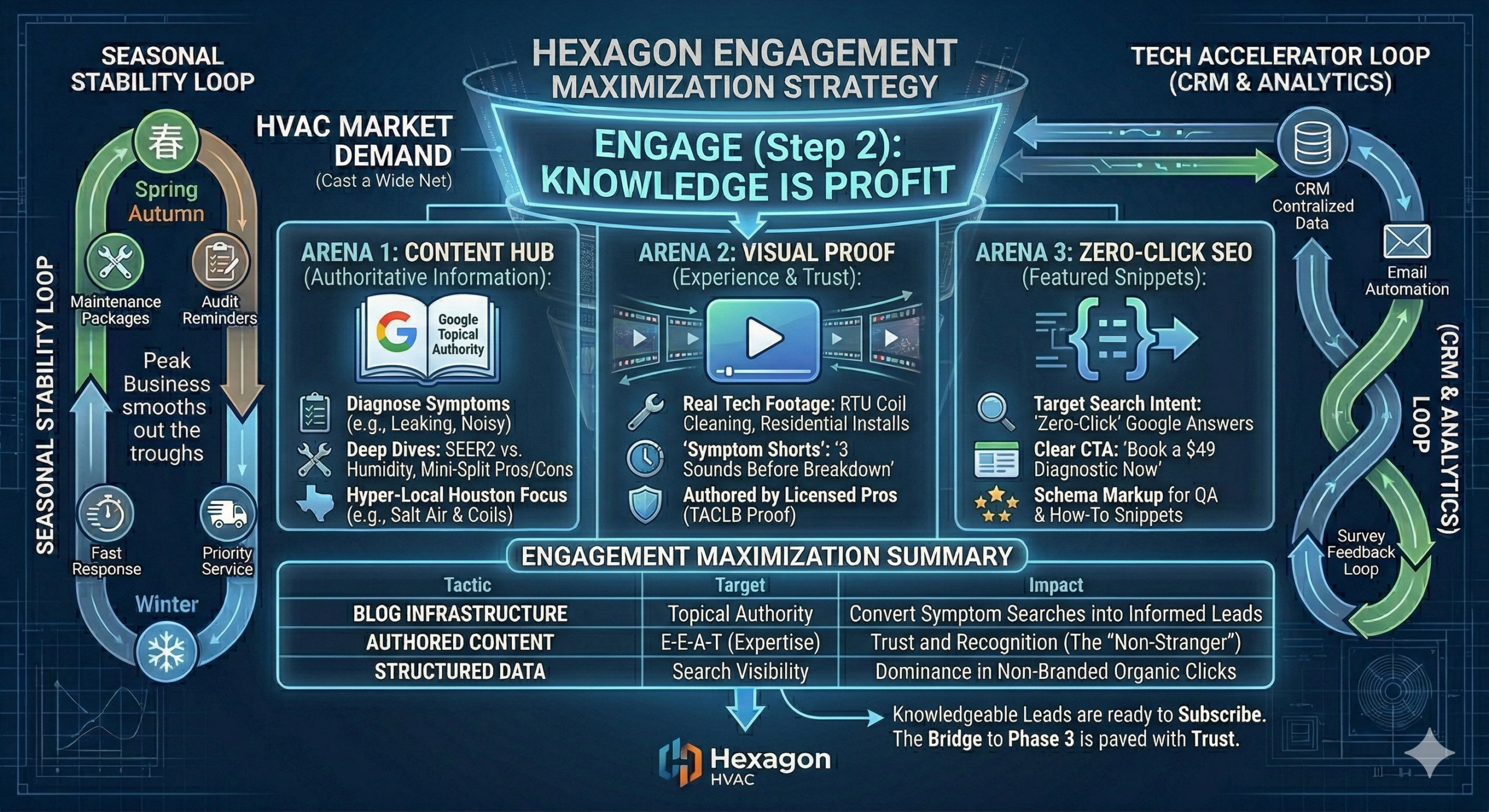
In the 8-Step Customer Value Journey, the Engage phase (Step 2) is the bridge between a stranger noticing your brand and a lead trusting you with their contact information.
While Awareness is about being seen, Engagement is about being heard and valued. For Hexagon Air & Heat, this is where you move from “just another HVAC company” to “the local experts who understand my problem.”
The Synopsis: “Knowledge is the New Currency”
The goal of the Engage phase is to get the prospect to spend time with your brand before they spend money. You aren’t asking for a sale yet; you are providing “Information Gain”—answering the specific questions keeping a homeowner or business owner up at night.
1. The Digital Handshake (Content & Interaction)
At this stage, the customer has a problem (e.g., a noisy AC, a high electric bill) and is looking for a solution. Hexagon engages them by providing that solution for free.
Educational Content: Deep-dive blogs like “Why is my Houston AC bill doubling?” or videos showing a real technician diagnosing a common coil issue.
Social Interaction: Responding to comments on Facebook or Instagram and sharing “Pro-Tips” that help people maintain their own systems.
Low-Friction Tools: Interactive chatbots or “Savings Calculators” that give the user immediate value without requiring a phone call.
2. Establishing E-E-A-T (Expertise & Trust)
Google and customers both look for “Experience, Expertise, Authoritativeness, and Trustworthiness” during this phase.
Authored by Pros: Ensuring content is signed off by a TACLB-licensed professional.
Visual Proof: Using real field photos (geotagged to Houston) to show you are actually doing the work you’re describing.
Zero-Click Value: Providing direct answers in “Featured Snippets” so the customer sees your expertise right on the search results page.
3. The “Non-Stranger” Effect
By the end of a successful Engage phase, the customer should feel a “connection” to Hexagon.
Consistency: Seeing the same brand voice and helpful tone across the website and social media.
Empathy: Content that acknowledges the stress of a broken AC in 100°F heat.
Transition to Step 3: Once they trust your advice, they are 10x more likely to Subscribe (give you their email) for a maintenance checklist or a discount code.
Engagement Success Metrics for Hexagon
| Metric | What it Tells You |
| Time on Page | Are they actually reading your expert advice or just “pouncing”? |
| Video View Rate | Are your “Symptom Shorts” keeping their attention? |
| Social Shares | Is your content so helpful that people are recommending it for you? |
TO DO LIST:
ONGOING
Diagnose Symptoms:
Add content to the relevant pages that describe what noises, leaks and other symptoms the customer might be experiencing and what the cause and resolution might be.
ONGOING
Deep Dives:
Add content to that gives a more detailed description of SEER ratings on equipment, possibly the change in refrigerants, etc.
ONGOING
Hyper-Local Houston Focus:
Add content that details how Houston weather effects the equipment longevity (ie. Salt water, summer heat, etc.)
ONGOING
Video Footage:
Add video content that shows technicians actively working on location. Modify (MetaData) using applicable Apps.
ONGOING
Photos:
Add photo content that shows technicians actively working on location. Modify (MetaData) using applicable Apps.
ONGOING
E-E-A-T:
Add video and photo content to every blog post to add validations.
CRITICAL
Schema Markup:
Add JSON to the top of each page that better details the specifics about the pages content:
@context: “https://schema.org”, @type: “HVACBusiness”
name: “Hexagon Air & Heat”,
image: “https://www.hexagonhvac.com/logo.png”
telePhone: “713-449-0084”,
url: “https://www.hexagonhvac.com”
address:
@type:
PostalAddress “addressLocality”: “Houston”, “addressRegion”: “TX”, “postalCode”: “77001”, “addressCountry”: “US” }
geo:
@type”: “GeoCoordinates”, “latitude”: 29.7604, “longitude”: -95.3698 },
openingHoursSpecification: “@type”:
OpeningHoursSpecification: “dayOfWeek”: [“Monday”, “Tuesday”, “Wednesday”, “Thursday”, “Friday”, “Saturday”, “Sunday”], “opens”: “00:00”, “closes”: “23:59”
