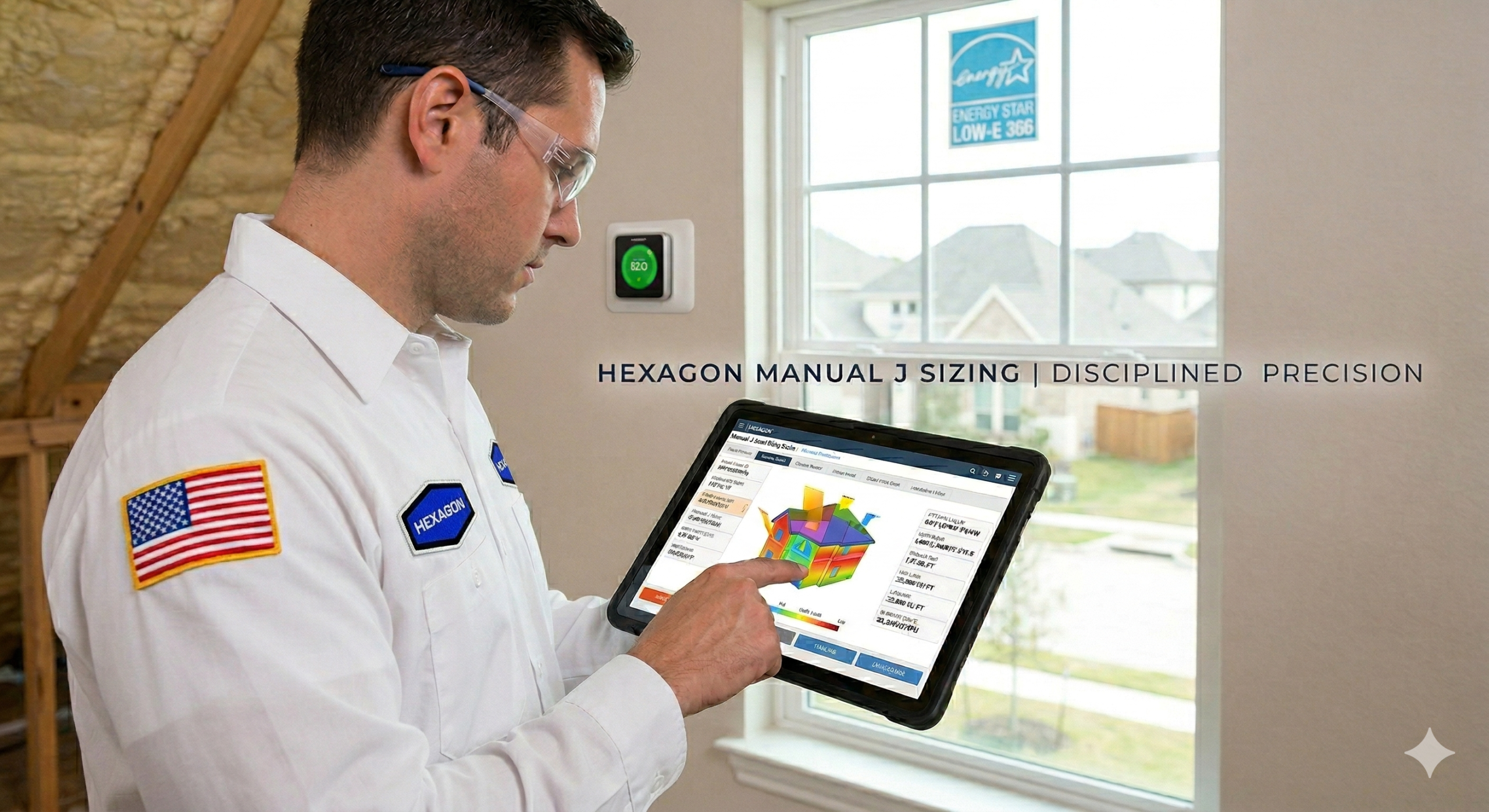
Manual J Load Calculation
The Manual J Load Calculation is the definitive, industry-standard protocol developed by the ACCA to ensure your HVAC system is engineered with disciplined precision rather than “rule-of-thumb” guesswork. Unlike basic estimates that rely solely on square footage, a true Manual J analysis evaluates your home’s entire thermal envelope, meticulously accounting for variables such as wall and attic insulation R-values, the total number and solar orientation of windows, local Houston climate data, and even internal heat gains from appliances and occupants. This rigorous process is essential for preventing the “silent killers” of HVAC efficiency: oversized units and short-cycling, which lead to localized hot spots, high indoor humidity, and premature mechanical failure. By calculating the exact sensible and latent heat loads of your property, we ensure your new installation provides maximum energy efficiency, superior dehumidification, and a longer system lifespan, protecting your architectural investment for years to come.
Hexagon Precision Sizing Estimator
A simplified Manual J approach considering orientation and insulation.
*Note: This is an estimate. A professional Manual J includes duct static pressure and latent heat loads.
Why Most HVAC Estimates Fail: The Danger of the "Square Foot Rule"
Many Houston homeowners are surprised to learn that two identical 2,500 sq. ft. floor plans can require completely different cooling capacities. Relying on a basic “square footage per ton” estimate is a gamble that often leads to poor performance and higher bills.
For example, a home in The Woodlands nestled under a heavy canopy of oak trees with North-facing windows has a significantly lower heat load than a home in Bridgeland with zero shade and massive, West-facing glass. While a “rule of thumb” estimate might suggest a 5-ton unit for both, the shaded home might only require a 4-ton system to operate efficiently.
The Perils of Oversizing: "Short-Cycling"
When a system is sized by square footage alone, it is almost always oversized. This leads to Short-Cycling—a phenomenon where your air conditioner turns on and cools the air temperature so quickly that it shuts off before it can perform its most important job: dehumidification.
In our Gulf Coast climate, an oversized unit leaves your home feeling “cold and clammy” because the humidity remains trapped inside. This moisture buildup doesn’t just impact your comfort; it creates a breeding ground for mold and causes unnecessary wear and tear on your compressor. At Hexagon, our Manual J Load Calculation replaces guesswork with disciplined precision, ensuring your system is sized perfectly for your home’s unique orientation, insulation, and environment.
Solar Heat Gain (Orientation)
In the high-intensity climate of the Texas Gulf Coast, Solar Heat Gain is often the single greatest variable in a Manual J Load Calculation, with West-facing glass acting as a literal greenhouse for your home. Unlike North-facing windows that receive consistent, indirect light, West-facing windows are exposed to the “afternoon bake”—the period when outdoor ambient temperatures are at their peak and the sun sits at a low angle, striking the glass directly. This short-wave radiation passes through the panes and is absorbed by your interior surfaces, where it is converted into long-wave thermal energy that becomes trapped inside your home’s thermal envelope.
Without the precise data provided by a Manual J calculation, a standard HVAC estimate will fail to account for this massive influx of infrared heat. At Hexagon, we quantify this heat gain to determine if your system needs additional sensible cooling capacity or if high-performance solutions like Low-E glass or solar shading are required to prevent your living room from becoming an unmanageable “heat pocket” during a Houston July.
R-Value Insulation
The effectiveness of your home’s thermal envelope is dictated by the R-value of your insulation, which measures its resistance to conductive heat flow. In many older Houston homes, such as those built in the 1970s or 80s, attic insulation typically sits at a meager R-19 level—roughly six inches of fiberglass—which allows a significant “heat leak” from the 140°F attic space directly into your ceiling. By contrast, modern building standards and Hexagon’s recommended “Superior” threshold utilize R-49 insulation (approximately 15–18 inches), which more than doubles the thermal resistance.
This massive difference in R-value fundamentally changes your Manual J Load Calculation: a home with R-19 insulation requires a significantly higher BTU capacity just to combat the heat radiation bleeding through the drywall. Upgrading to R-49 or spray foam doesn’t just lower your monthly energy consumption; it allows us to size your HVAC system with “Disciplined Precision,” potentially reducing the required tonnage and ensuring the equipment doesn’t have to fight a losing battle against a poorly insulated attic.
Internal Loads
A modern, high-end kitchen is a massive heat generator. Professional-grade appliances—such as high-BTU gas ranges, dual convection ovens, and large-capacity built-in refrigeration—emit substantial sensible heat during operation. Even high-efficiency dishwashers and luxury espresso machines contribute to the thermal load of the room.
In the open-concept floor plans common in Houston and The Woodlands, a kitchen in full use can easily raise the temperature of the surrounding living areas by several degrees. If your Manual J calculation fails to account for these internal “heat spikes,” your air conditioning system will struggle to maintain a consistent setpoint while you are cooking or entertaining. At Hexagon, we document the specific heat output of your culinary suite to ensure your system has the dedicated capacity to neutralize these Sensible Heat gains, keeping your kitchen crisp and comfortable even during a multi-course dinner preparation.
Why Envelope Tightness Matters for Sizing
If we size a system based purely on square footage without accounting for a high Infiltration Rate, the system will likely underperform during the hottest part of the day. A “leaky” home requires a higher BTU capacity to overcome the constant influx of heat and moisture.
At Hexagon, our Disciplined Precision approach involves evaluating these leak paths. By identifying a compromised envelope, we can either adjust the system sizing to compensate or, more importantly, recommend targeted air-sealing. This ensures your new HVAC system isn’t just cooling the air, but effectively maintaining a pressurized, dehumidified environment that stays crisp regardless of the heat in your attic.
