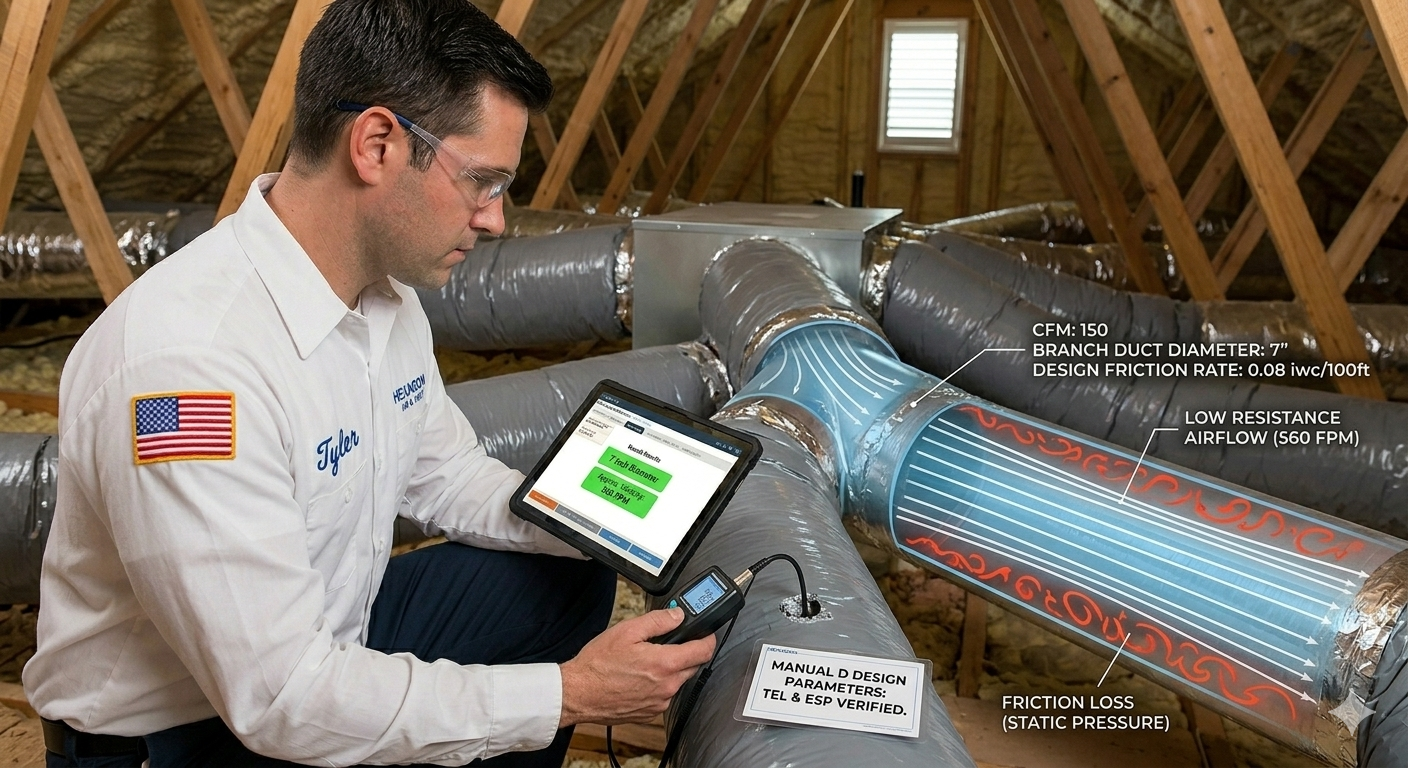
Manual Duct Design Calculation
The Manual D Duct Design Calculation is the definitive, industry-standard protocol developed by the ACCA to ensure your home’s air distribution system is engineered with disciplined precision rather than “rule-of-thumb” guesswork. Unlike basic installations that rely on generic flexible duct sizing, a true Manual D analysis evaluates the specific External Static Pressure of your equipment, meticulously accounting for variables such as total effective length, fitting pressure losses, and the required Cubic Feet per Minute (CFM) for every individual room. This rigorous process is essential for preventing the “silent killers” of HVAC performance: high static pressure and restricted airflow, which lead to excessive blower motor noise, uneven room temperatures, and premature component failure. By calculating the exact duct diameters and branch layouts required for your property’s unique architecture, we ensure your new installation provides whisper-quiet operation, balanced comfort in every corner of the home, and maximum energy efficiency, protecting your mechanical investment for years to come.
Hexagon Manual D Duct Sizer
Calculate required duct diameter based on CFM and available static pressure.
*Note: This utilizes the ASHRAE friction formula. Manual D requires calculating Total Effective Length (TEL) for certified accuracy.
The "Equivalent Length" Concept
Most customers think a 10-foot duct is just 10 feet of resistance. In reality, every turn, T-junction, and register adds “equivalent length.”
The Explanation: A single 90-degree elbow can add the same resistance as 30 feet of straight pipe. If a technician doesn’t use Manual D to account for these fittings, the air will lose its “momentum” before it ever reaches the bedroom. This is why some rooms are always 5 degrees warmer than others.
Velocity vs. Volume (The "Garden House" Analogy)
Homeowners often confuse “blowing hard” with “cooling well.”
The Explanation: If you put your thumb over a garden hose, the water shoots further (Velocity), but the amount of water coming out stays the same (Volume). In HVAC, high velocity caused by small ducts creates noise. Manual D ensures the ducts are sized for high volume at low velocity, providing a whisper-quiet home where you feel the cooling without hearing the roar of the fan.
Turbulence and "Dead Zones"
When air isn’t “spread” correctly, it creates pockets of stagnant air.
The Explanation: Manual D works in tandem with Manual T (Air Distribution). It ensures that the air leaving the duct has enough “throw” to mix with the room air. Without this calculation, cold air might simply “dump” onto the floor, leaving the ceiling (and the occupants) feeling warm and stagnant.
Blower Motor Burnout
This is the strongest argument for the “Precision” customer.
The Explanation: Modern high-efficiency systems use ECM (Electronically Commutated Motors). These motors are “smart”—if the ducts are too small (High Static Pressure), the motor will spin faster and harder to force the air through. This leads to a massive spike in your electric bill and can cause a $1,000+ motor to burn out in 5 years instead of lasting 15.
The "Dirty Filter" Myth
- The Explanation: Many homeowners think a “high-efficiency” thick pleated filter is always better. However, if the ductwork wasn’t designed (Manual D) to handle the restriction of a thick filter, it will “choke” the system. We use Manual D to ensure your filter rack and ducting are matched so you can have clean air without killing your compressor.
